

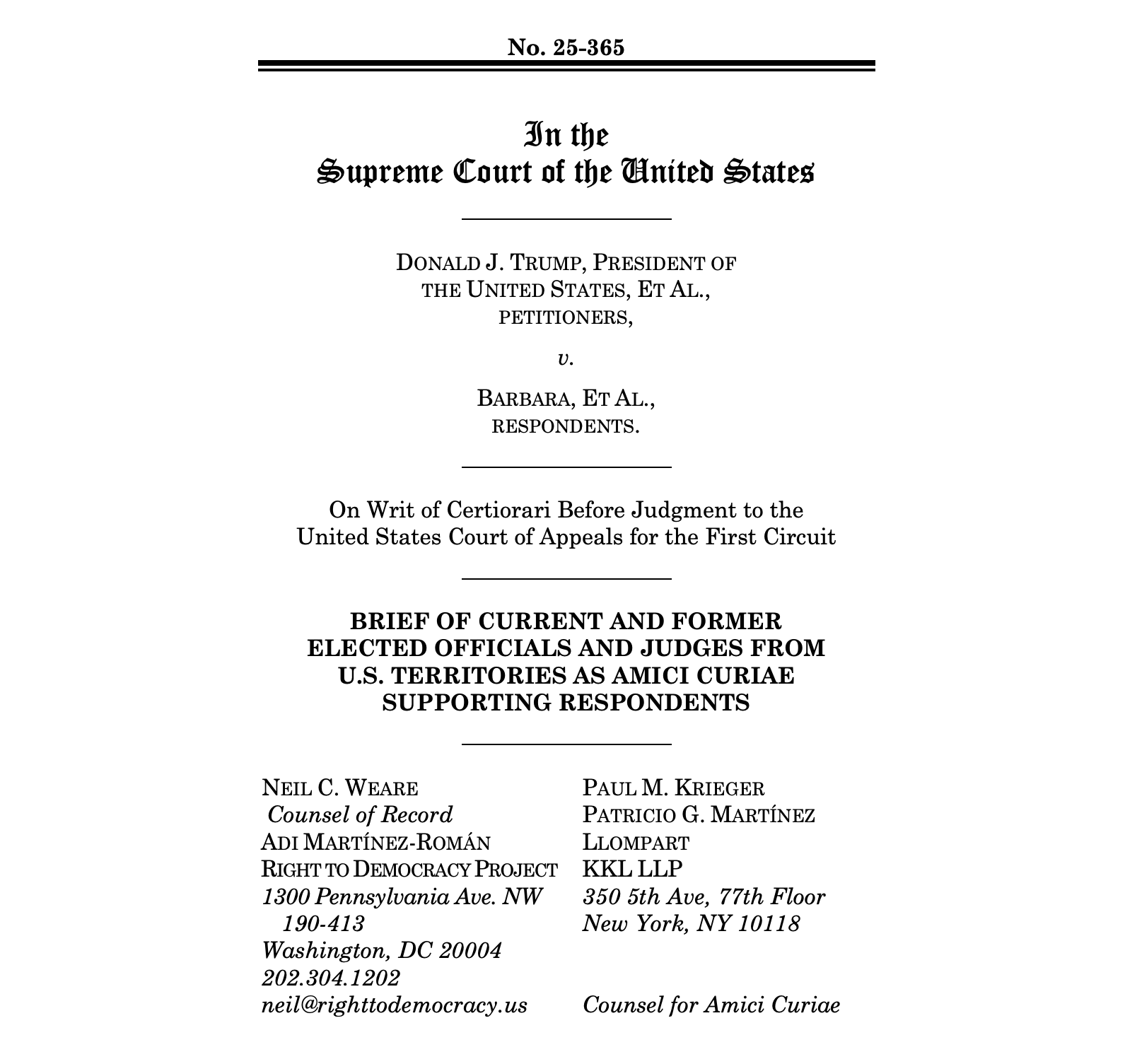
Trump v. Barbara — Amicus Brief
STATUS: Decided
COURT: U.S. Supreme Court
OVERVIEW
On July 30, 2026, the U.S. Supreme Court ruled that President Donald Trump’s attempt to redefine the long-settled understanding of the Citizenship Clause to exclude children born to parents who are temporary or unauthorized immigrants violates the Citizenship Clause of the Fourteenth Amendment. Right to Democracy filed an amicus brief on behalf of 21 current and former elected officials and judges from the U.S. Virgin Islands, Puerto Rico, Guam, the Northern Mariana Islands, and American Samoa who span the political spectrum and hold diverse views on questions of political status. They each reject the idea that Congress or the President can—consistent with the Citizenship Clause of the Fourteenth Amendment—unilaterally deny U.S. citizenship to those born under the sovereignty and jurisdiction of the United States. At the same time, they each support the distinct issue of a right to self-determination and decolonization—whether that is towards a continuing or separate relationship with the United States.
WHY THIS CASE MATTERS
The Citizenship Clause of the Fourteenth Amendment guarantees citizenship to anyone born “in the United States” and “subject to the jurisdiction thereof.” For over a century, the Supreme Court has avoided answering whether people born in U.S. territories —which are indisputably under U.S. sovereignty and jurisdiction—have a constitutional right to citizenship under that Clause. Supreme Court deference to the political branches has left the question of birthright citizenship in U.S. territories subject to political manipulation. This uncertainty is an obstacle to self-determination because it obscures how changes to political status may or may not impact questions of citizenship.
While the Supreme Court’s ruling in Trump v. Barbara did not address the question of birthright citizenship in U.S. territories, its reasoning suggests how it might approach that question in the future. Notably, Justice Jackson, in a concurring opinion joined by Justice Sotomayor, called out the Insular Cases as an example of instances in which the Supreme Court has “denied Americans” the “promise” of “securing equal citizenship”.
VOICES FROM THE CASE
“While today’s decision did not directly address the question of birthright citizenship in U.S. territories, the Court is clear that anyone born on U.S. soil and subject to U.S. law has a constitutional right to U.S. citizenship.’. The Court definitively ruled that the political branches of the federal government have no power to redefine the Citizenship Clause. This is significant for people born in U.S. territories, because the federal government continues to argue––contrary to the text and history of the Citizenship Clause––that it can turn citizenship on and off in U.S. territories. It is also noteworthy that Justice Jackson, in a concurring opinion joined by Justice Sotomayor, also called out the Insular Cases as an example of when the Supreme Court has ‘denied Americans’ the ‘promise’ of ‘securing equal citizenship.” –– Neil Weare, Co-Director of Right to Democracy.

“The Court’s broad ruling today is a recognition that, absent very narrow exceptions, the U.S. must recognize fundamental citizenship rights to all of the people who are born under their rule. The language of the Court is clear––that neither the President nor Congress has the power to unilaterally deny U.S. citizenship to someone born under the sovereignty and jurisdiction of the United States. Regardless of one’s views on political status, this re-emphasizes the important constitutional limits placed on federal power when it comes to the fundamental right of citizenship. Understanding what basic rights are recognized to people born under U.S. sovereignty is critical to the conversation of self-determination.”— Adi Martínez Román, Co-Director, Right to Democracy

“The President and Congress have broad powers. But as the Supreme Court ruled today, absent from those powers is the ability to turn the Constitution’s guarantee of birthright citizenship on and off whenever they like. This is an important ruling for Virgin Islanders because the federal government continues to claim our citizenship is a legislative privilege rather than a constitutional right. That’s not just contrary to the Constitution, but contrary to the 1917 Treaty of Transfer, which expressly recognized that Virgin Islanders would be recognized as U.S. citizens.” –– Congresswoman Stacey Plaskett, the U.S. Virgin Islands in Congress
“Today's decision should serve as a roadmap for recognizing that people born in U.S. territories have a constitutional right to U.S. citizenship that neither Congress nor the President can take away. No elected official or legislative body should have a veto over whether someone born in Guam or anywhere else on U.S. soil is a U.S. citizen. Whatever the people of Guam decide regarding our future political status, so long as we are under the U.S. flag, we should be entitled to equal citizenship and equal rights.”––Mary Camacho Torres, Senator, Guam Legislature (2015 to 2023)
“Today's ruling confirms what we argued: the political branches do not have unilateral power to define who is and isn't a citizen. Just as the Court struck down the Executive Order as unconstitutional, it must eventually recognize that neither Congress nor the President have unilateral control over the question of citizenship in U.S. territories. This is also true of the colonial relationship between the United States and Puerto Rico—which is rooted in the same racist and colonial prejudices as the challenged Executive Order. It is time to end the federal government’s unilateral power over people in the territories and begin an informed process of self-determination and decolonization.”––Ana Irma Rivera Lassén, Senator, Puerto Rico (2021-2025)
“As Puerto Ricans, we recognized firsthand what was at stake when the President sought to exclude the children of immigrants from the protections of citizenship, and the Court was right to reject that exclusion today. But it should not stop there: birthright citizenship must also be recognized for those born in U.S. territories, who have historically been denied equal treatment.” –– Zoe Laboy, Senator, Puerto Rico (2017-2019)
“I applaud the Supreme Court’s powerful reaffirmation that birthright citizenship is a constitutional guarantee that no President can erase by executive order. The Court’s sweeping principle—that a child born on American soil and subject to American law is a citizen—cannot logically be confined to the states. In my reading, that principle equally protects those born in the territories of the United States, including Puerto Rico.” –– Eduardo Bhatia, President of the Senate of Puerto Rico (2013-2017)
“Federal officials cannot just redefine whether or not someone has a right to citizenship - that was the clear message from today’s decision. With so many of our American Samoan brothers and sisters facing criminal prosecution in Alaska because the federal government denies them recognition as U.S. citizens, this Supreme Court ruling is important for our community.” –– Andra Samoa, Representative, American Samoa’s Fono (2019-2022)
“It is the role of a judge to say what the law is, and that is just what the U.S. Supreme Court did today. The Justices were clear that no government official has the power to deny citizenship to anyone granted that right by the U.S. Constitution. This should be true not just for the Trump Executive Order, but for people born in U.S. territories.” –– Soraya Diase-Coffelt, Judge, Superior Court of the Virgin Islands (1994-2000)
The full list of amici includes:
- Stacey E. Plaskett: U.S. House of Representatives, U.S. Virgin Islands (2015-Present)
- Albert Bryan Jr.: Governor, U.S. Virgin Islands, (2019-Present)
- Tregenza Roach: Lieutenant Governor, U.S. Virgin Islands (2019-Present); Senator, U.S. Virgin Islands Legislature (2013-2018)
- B.J. Cruz: Public Auditor of Guam (2018-Present); Speaker, Guam Legislature (2017-2018); Senator, Guam Legislature (2005-2016); Chief Justice, Supreme Court of Guam (1999-2001); Associate Justice, Supreme Court of Guam (1997-1999); Judge, Superior Court of Guam (1984-1997)
- Aníbal Acevedo Vilá: Governor, Puerto Rico (2005-2009)
- Sila M. Calderón: Governor, Puerto Rico (2001-2005)
- Alejandro García Padilla: Governor, Puerto Rico (2013-2017)
- Kenneth E. Mapp: Governor, U.S. Virgin Islands (2015-2019)
- Donna M. Christian-Christensen: U.S. House of Representatives, U.S. Virgin Islands (1997-2015)
- Gregorio Kilili Sablan: U.S. House of Representatives, Northern Mariana Islands (2009-2025)
- Sheila Babauta: Northern Mariana Islands House of Representatives (2021-2023)
- Eduardo Bhatia: Puerto Rico Senate (2009-2021), President of the Senate (2013-2017)
- Zoé Laboy: Puerto Rico Senate (2017-2019)
- José Bernardo Márquez Reyes: Puerto Rico House of Representatives (2021-2025)
- Ana Irma Rivera Lassén: Puerto Rico Senate (2021-2025)
- Andra Samoa: American Samoa House of Representatives (2019-22)
- Mary Camacho Torres: Senator, Guam Legislature (2015-2023)
- Charles Ala'ilima: High Court of American Samoa District Court Judge/Acting Associate Justice (1981-1985); District Court Judge Pro Tempore (1996-1998)
- Adam G. Christian: Judge, Superior Court of the Virgin Islands (2010-2016)
- Soraya Diase Coffelt: Judge, Superior Court of the Virgin Islands (1994-2000)
- Liana Fiol Matta: Chief Justice, Supreme Court of Puerto Rico (2014-2016); Associate Justice (2004-2014); Judge, Puerto Rico Court of Appeals (1992-2002)
CASE MATERIALS
ADDITIONAL RESOURCES
Do you like this page?